
 The database of the project “Cross-Cultural Discourses: Portugal, Britain and the Press” has entered the classrooms of NOVA FCSH, or at least one of them. This semester, I had the opportunity to teach the course “Anglo-Portuguese Cultural Crossways” of the Master in Trends in English and North American Studies, a course similar to one I myself attended when I was a Master’s student, almost a decade ago.
After introducing the students to the basics of Anglo-Portuguese studies, cultural studies, imagology, and Stuart Hall’s (1932-2014) theory of representation, we turned to the First Portuguese Republic (1910-1926) and its historical and cultural context. We also received the visit of Ana Catarina Marques dos Anjos (FLUP/CETAPS), who presented a talk entitled “Britain between the Wars: The Bright Young People Reconsidered”. Next, we shifted our focus to the digital humanities, exploring different definitions of this field of study, examining its main concepts, and elaborating on the ways in which technology incorporates biases.
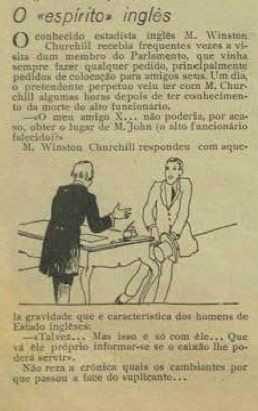
With this theoretical framework in mind, we looked at the database of the CETAPS project mentioned above, and in one of the classes, students were asked to select articles from the database and analyze them, taking into account all they had learned. One of the articles selected by a group of learners was the humorous anecdote presented in the piece that illustrates this post, entitled "Ecos, Noticias e Curiosidades: O 'Espírito' Inglês” (O Notícias Ilustrado, 1929). In it, we find Winston Churchill (1874-1965) and an unidentified English member of Parliament, the last of which is portrayed as both corrupt and effeminate.
Hopefully, there will be more news soon about how the project “Cross-Cultural Discourses: Portugal, Britain and the Press” continues to make inroads in other spheres of academia.