

We recently hosted Professor Mauro Sarrica at the Centre for a few days. He is a Full Professor of Social Psychology from the Sapienza University of Rome and will soon be joining the University of Padua. Given that his research spans environmental and peace psychology, we organised a roundtable on the social aspects of the energy transition. The following day we had the opportunity to briefly interview him regarding his work on the matter. We discussed not only this topic in relation to his home country, Italy, but also within Europe as a whole. Furthermore, Professor Sarrica provided us with his insights regarding the downsides and consequences of this process, as well as potential solutions to its issues. Plus, we learned about how people from different communities react to the energy transition, as well as their deflection of their agency in the matter. Besides, on a more casual note, he gave advice to postgraduate students about their work and how it might relate to his own. We have included a transcript of the interview below (audio coming soon!).
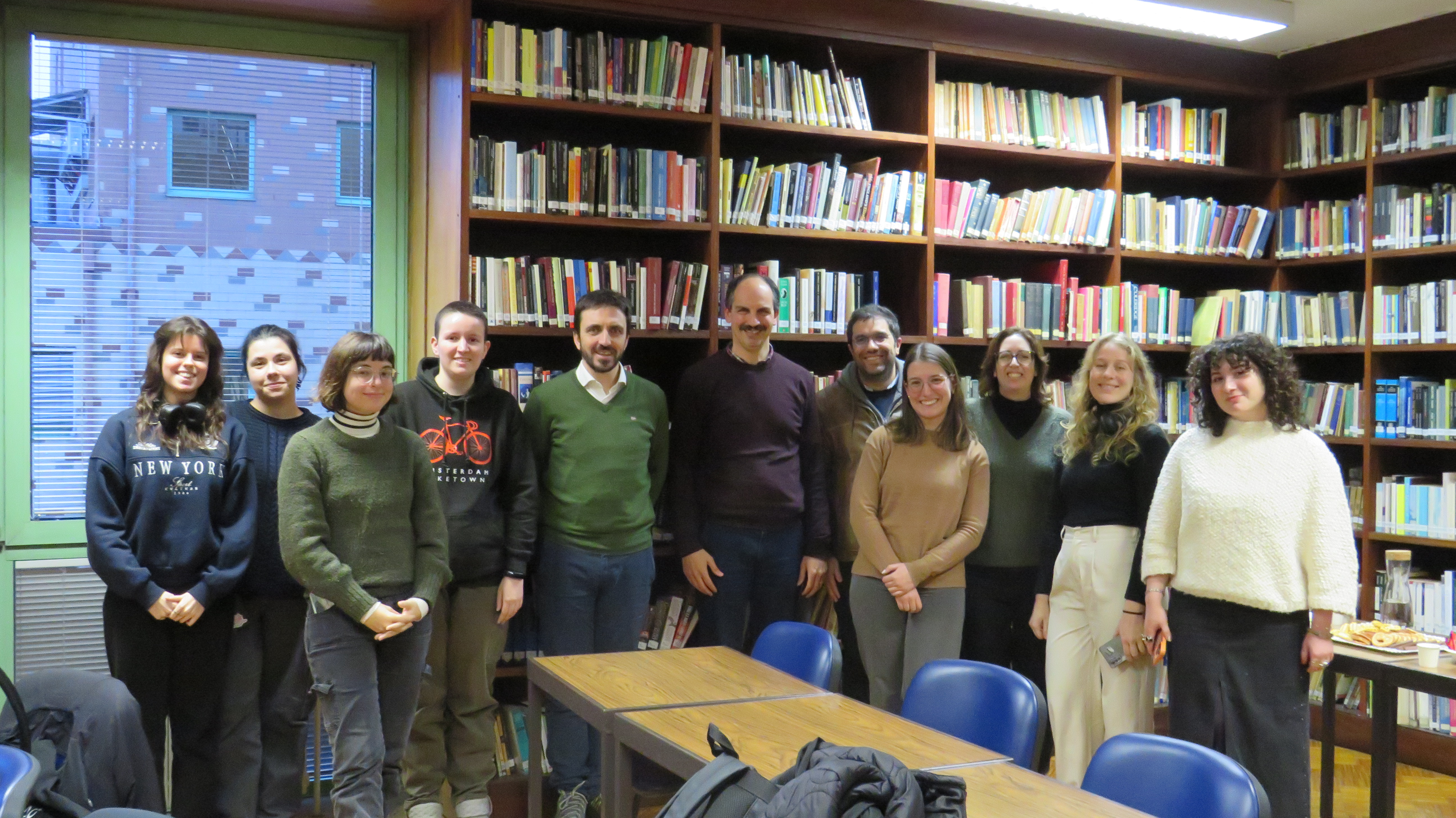
Professor Sarrica’s visit proved to be very fruitful, as he provided new perspectives and opinions on these current concerns and opened a path for an enlightening and interdisciplinary conversation. This kind of collaborative activity allows for a reciprocal relationship between different researchers and their fields. Since we come from Literary and Cultural Studies, we appreciated getting further insights into questions that we were acquainted with superficially from someone who has studied them extensively. Specifically, we would like to highlight the connection between the energy transition and neocolonialism, which interests us greatly. We hope that Professor Sarrica’s words will resonate with others as they did with us.
Interview Transcript
Interviewer: Thank you so much for talking to us today, Professor Sarrica, and we’d like to ask you some questions related to your research. We understand that you’ve been focusing on the energy transition in Italy, and we would like to ask you: how would you say that it compares to other European countries or even within Italy, between different regions?
Professor Sarrica: Thanks for the question, it’s actually very difficult to answer because on the one hand you have kind of overarching policy framework[s], so that if you look at the energy transition—my understanding of it—if you look at energy transition, let’s say from a certain distance, it actually seems that we have a homogenous transformation of the sources and also of the way of consuming energy.
But then, as a psychologist, as a social psychologist, we tend to look at a different scale, so not just the European scale, but then we try to close and zoom at the national level and then at the regional, at the community level, and that’s where you can see different transition[s]. Many years ago [2016] we wrote a special issue entitled “one hundred thousand energy transition[s]” (DOI: 10.1016/j.erss.2015.12.019), precisely to mean that the more you zoom in [a] specific region, the more you can see that there are different speed[s], for example; people who are totally left out of the transition or even who are paying a price for some environmental degradation that to a certain extent is not their fault. So, in the transition, in my opinion, it’s important to understand the speed, to understand who is actually owning the transformation, and if we are just looking at the transformation of technologies or if we are actually also fostering a transformation of values, for example, of habits. In this sense, some are very advanced, other[s] are left behind, not because [it’s] their fault, but because of the way in which people are engaged. And also, my opinion makes no sense to imagine, you know, coming from the south of Europe, and then to imagine that in the north of Europe you have a better situation. In my opinion, this is not at all the case, we have very positive cases also, for example in Italy, even in the south of Italy, for example, there are very advanced context[s], precisely because they combine a transformation of values and new technologies.
I: Thank you very much, and it seems that one of the reasons why people reject some aspects of the energy transition is because it can affect the landscape around them, for example, in the case of lithium and cobalt mining. In your experience, why do you think this happens and how can we embrace this process without drastically changing the topography?
S: Acceptance and acceptability are, again, a very big topic. On the individual level, we can say that acceptability and then acceptance of technology has to do with different values, different belief[s], for example, about the kind of change that new technologies are bringing, this as a general comment. In terms of landscape this is even more interesting because the perception of the landscape is, of course, culturally rooted, so we have to understand what meanings are associated to a specific landscape [and] by whom. As I was saying yesterday, for example, it’s curious how sometimes it’s not the local[s] who want to preserve the landscape, precisely because for them the landscape is a place of transformation, in which the local communities have always been involved; we don’t have in Europe natural landscape[s], every landscape is socially constructed. In this situation, for example, sometimes [there] are people from the cities, to put it simpl[y], who want to preserve the landscape because there is an assumption of nature as a place for leisure, as a place for restoration, and not as a place for everyday activity. In this sense, I don’t necessarily think that we must preserve the landscape; the point is, once again, if we are able to listen to the people that, to some extent, are interested in living, in going, in visiting, in enjoying the place, then the role of politics should be to manage the conflict rather than make a monologue about what can be preserved, what should be preserved and what [should] not.
I: It’s certainly a very rich topic, and now moving on to another question: us, as researchers in cultural studies, can’t help but think of Post-Colonial Theory and the notion of neocolonialism. Why are people so attached to preserving their own culture and history but are willing to turn a blind eye when other communities are being harmed by resource extraction?
S: In my opinion, a post-colonial approach is extremely relevant when we are talking about energy transition. And I’m not thinking about colonies as a space—I don’t know like in Latin America or in Central Africa—I’m not thinking of colonies in this way, I’m thinking of colonies, being a psychologist, from a psychological perspective. So, the idea that you perceive yourself or you assume the identity of the colonised. And if you shift and move [on] from the idea of colonies as a geographical space rather to the idea of colonies as a self-perception, then you can see that [the] same dynamics can happen even within a country, even among different region[s], even among the relationship[s] between, let’s say, cities and the rural areas. Here, one of the answer[s] that I can give you has to do with inter-group relationship[s], so the fact that we are—also as a form of coping, somehow—we are ready to deny, we are ready to enter into different state[s] of denial in which one state of denial is, of course, the most evident: “this is not happening”; but there are other state[s] of denial that are more tricky [sic]: “yes, it’s happening but what can we do?”, or “it’s happening, but it’s not my fault,” so, this kind of moral disengagement, [as it] is called. We have to understand that we are all responsible, to some extent, and in any case the effect of what is going on will affect us all as human beings, so the problem is a problem of recategorization. Rather than thinking about different groups—say different countries, different region[s], cities, and rural areas—we should recategorize our understanding of the [world]. And. in this sense, some positive examples are, [at] present, when we think about cross-national social movement[s], for example, where the problem has to do with us as human beings, in this human and non-human connection, rather than thinking of oursel[ves] as countries or as citizen[s] of some region and not of other.
I: And now moving on to the last question—considering that in 2026, CETAPS is focused on cultural sustainability, we can’t help but wonder how we may be able to reconcile the preservation of physical media—such as books or CDs—and the depletion of resources. In your opinion, how can this balance be achieved?
S: That’s a major problem, for example also now, with the emphasis on Artificial Intelligence, and, once again, it has to do with our—as human beings—our capacity to deny evidence, no? We are all intrigued by Artificial Intelligence, for example, as well as other digital devices, they are so useful for us that, as a way of managing inconsistency, we are happy to deny the effect that these tool[s] have. So, how to combine, you know, the opportunities, let’s say, of the digital and the preservation of the heritage and sustainability? It’s clearly—I don’t have an answer—it’s a really interdisciplinary effort, I think already the fact of asking this question is already a good starting point because it makes evident what, for most of us, is not so clear, not so clear yet, so, probably, the starting point is to create awareness, to create awareness that what we are using—which seems immaterial, which seems in the cloud, abstract—actually has some very concrete, physical impact on the environment. And so, after building awareness, we should reason together if the growth, the assumption about growth that is behind also this kind of new technological advances is really a given or if it is, in itself, a cultural product. And so, in this sense, we could reason on how to deconstruct the assumption that this is necessary, this is the only future, and maybe imagine—and this is your task, probably—help us imagine an alternative future.
I: Thank you so much.